Scope process lets you consider only those scope changes that your project and the stakeholders agree.
Control scope process save you from situations such as scope creep and gold plating. So, you are not going to ask the project team to work on every change that occurs in the project.
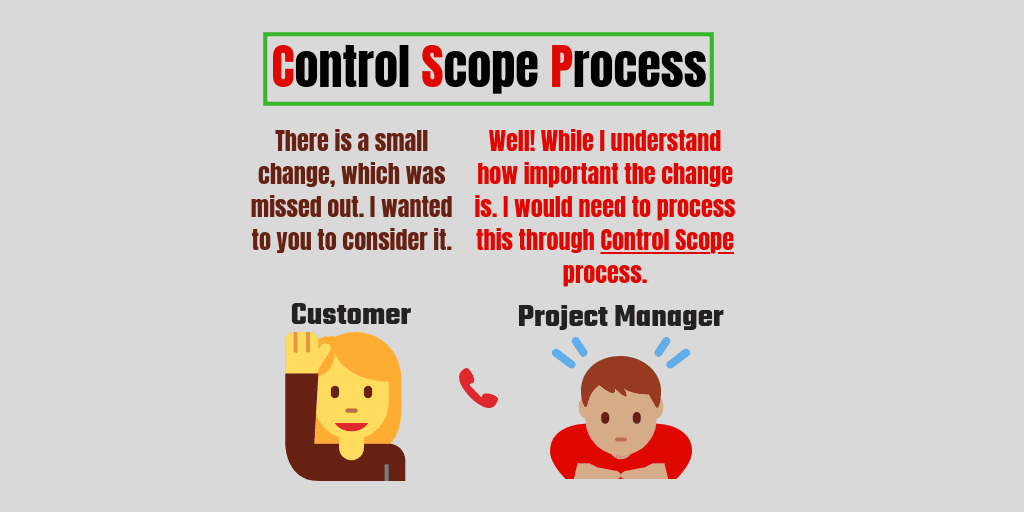
Control Scope Process – Important Scope Management Process
Even, if the ask is from the customer, it would be wise to have a process to see, whether the change is appropriate for the project.
Is the Change Good or Bad for the Project?
Change is inevitable. Change may come from any of the stakeholders. For instance, it may come from sponsor, or the team or any of the other internal/external stakeholders.
As a project manager, you must assess the impact of the change and take the change, through perform integrated change control process, to either approve or reject the change.
In the perform integrated change control, you assess the impact of the change to the project and see whether the project requires that change or not.
Once the change gets approval, you must compare it with the base line to see, how big the change is. And accordingly re-baseline your project management plan, scope, and other project documents.
Steps to Control Scope Process Using Variance Analysis
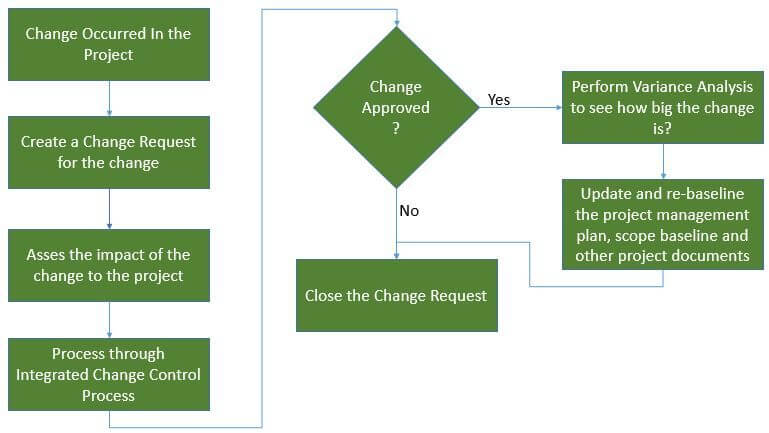
Control Scope Process – Change-Management – Variance Analysis
- Change Occurrence in the project – one or more of the stakeholder(s) request the change in the project.
- Create Change Request – The first thing that you are going to do is to document the change by creating a change request
- Assess the impact of the change to Project constraints such as scope, time, cost, quality, risk, resources.
- Process the change through integrated change control process, which we learnt in project integration management knowledge area.
- If the change does not approve, then close the change request.
- If the change gets approval, then perform Variance Analysis to understand how big the change is. And how much variance the project has compare to its baseline.
- Update all the necessary project documents such as project management plan, scope baseline, other project documents and re-baseline them.
When to Perform Control Scope Process

When to Perform Control Scope Process
To perform control scope process, you at least need one scope baseline. Before you create scope baseline, you do not have a concrete scope that exists for the project.
So, you can perform control scope process since you create your first scope baseline till the end of the project.

Control Scope Vs Validate Scope
Control scope can appear even before or after Validate Scope process. Meaning that, during validate scope process, if you identify any scope issues, you would again must perform control scope process. So you perform the control scope process, at any point of time in the project, but only after you create your first scope baseline.
Control Scope Process – ITTOs
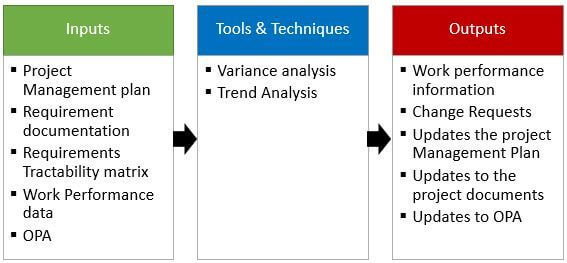
Control Scope Process ITTOs
Inputs
- Project Management Plan is a very broad document which contains information pertaining to scope. For instance, scope management plan, scope baseline, requirements management plan, change management plan, and the configuration management plan. We have learnt earlier that scope baseline comprises of WBS, WBS Dictionary and the project scope statement. So project management is one of the primary inputs to the control scope process.
- Requirements documentation is essential to compare the change with original requirement(s) in the requirements documentation.
- Requirements Traceability Matrix helps the project manager to understand the traceability of the original requirement with respect to the requirement changes. Also it tells the project manager the source of requirements and the stakeholders pertaining to that requirement to consult with.
- Work Performance data provides all types of project performance data so that project manager can assess where the project is and how much impact the change brings to the project.
- Organizational Process Assets include policies and guidelines pertaining to scope control for historical projects. Also monitoring and reporting methods and templates from historical projects may help here.
Tools & Techniques
- Variance Analysis is comparing the change to the baseline and understand how big the change is and what the variation is.
- Trend Analysis tells you how the project is performing over the period. It tells you whether the project performance is increasing or decreasing over the period.
Outputs
- Work performance information is the output from work performance data. It is correlated and contextual information made from work performance data.
- Change Requests – When you analyze the project performance and compare it with the baseline, it may result in change requests to the project.
- During variance analysis, if you see the variance from the baseline, then you update the project management plan, project documents and the appropriate organization process assets.
Summary
Control scope process is to deal with controlling the scope changes in the project with the help of perform integrated change control process and other tools such as variance analysis.
Control scope process lets you perform only those changes, which are essential in the project in agreement with the stakeholders.
Primary inputs to the control scope process are project management plan, requirements document, requirements traceability and work performance data.
The primary tool is variance analysis. Variance analysis is when you compare the change impacts to the baseline and figure out how big the change is. Also trend analysis also helps you understand how the project is performing over time.
The primary output of the control scope process is the change requests and work performance information. Change requests are approved changes which are resulted by variance analysis and trend analysis.


